
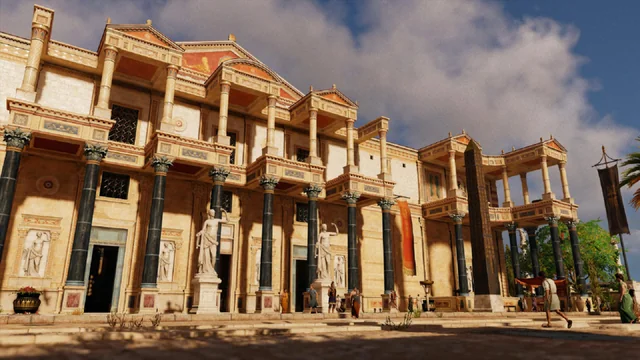
 A Window into Ancient Egypt and the World
The Library of Alexandria was one of the most famous libraries of the ancient world. It was built in the Egyptian city of Alexandria during the reign of Pharaoh Ptolemy II (around the 3rd century BCE). Its goal was to collect all the world’s knowledge and make Alexandria the center of learning and scholarship.
The library became a major center for scholars, scientists, mathematicians, and philosophers from across the ancient world. It is believed that thousands of works from Greece, Egypt, India, Mesopotamia, and other civilizations were housed there. The library symbolized the pursuit of human knowledge and the desire to preserve and share it.
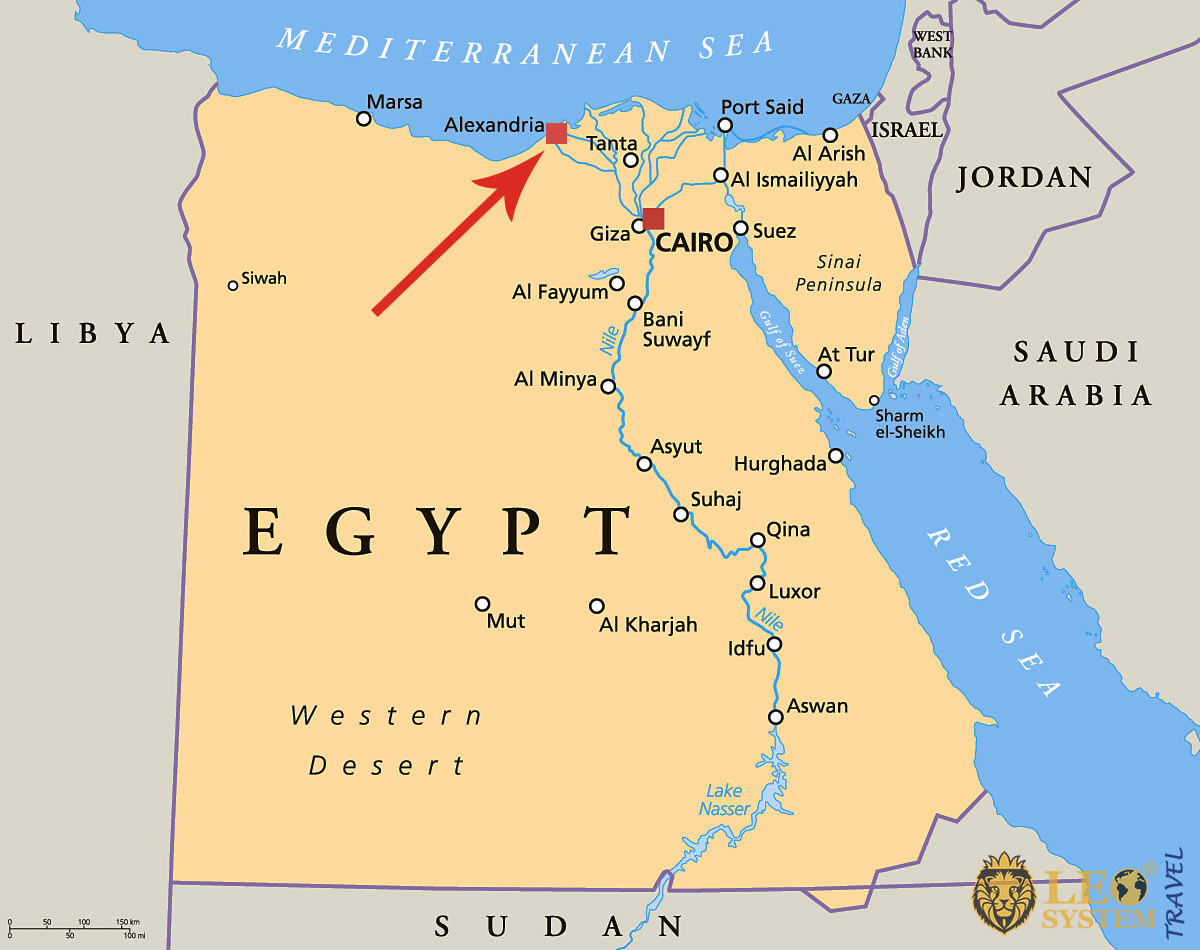 This map of Egypt shows the Nile River and the city of Alexandria.
Egypt is located in the northeastern corner of Africa, along the Nile River. On a world map, you can find Egypt just below the Mediterranean Sea. Alexandria is found on the northern coast of Egypt, right on the edge of the Mediterranean. By locating both Egypt and Alexandria on a map, students can see how its location made it an important center for trade, culture, and knowledge in the ancient world.
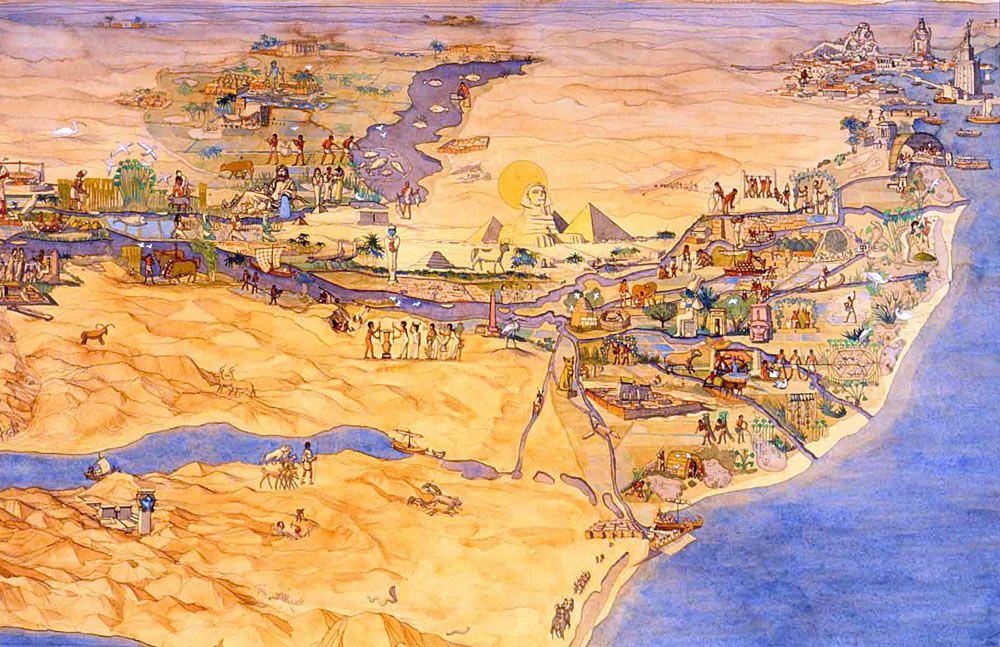 The Nile River was the lifeline of ancient Egyptian civilization.
Its annual floods left behind rich, fertile soil that made farming possible in an otherwise desert region. Egyptians grew wheat, barley, and other crops along its banks, which provided food and stability for their society. The Nile also served as a natural highway, allowing people to travel and trade easily between cities. Boats carried goods such as grain, stone, gold, and papyrus up and down the river, connecting Egypt with neighboring regions. Because of the Nile’s vital role in both agriculture and transportation, it shaped nearly every aspect of Egyptian life and helped the civilization thrive for thousands of years.
The Scrolls of the Library
Instead of books, the Library of Alexandria contained scrolls made of papyrus. Estimates suggest it may have held between 400,000 and 700,000 scrolls. These covered topics such as literature, history, medicine, mathematics, astronomy, and philosophy. Many original works of ancient authors, as well as translations of texts from other cultures, were stored here. Sadly, most of these scrolls were lost when the library was destroyed.
The Legacy of the Library of Alexandria
Even though the library no longer exists, its story has lived on as a symbol of knowledge, learning, and the importance of preserving information. Modern libraries and digital archives are often compared to the Library of Alexandria as they continue the mission of gathering and protecting human knowledge.
Thanks to the library, Alexandria became the centre of learning and knowledge for the entire Mediterranean world for over 600 years, and legends grew up around it. Here is the story of Alexandria, the most famous city founded by Alexander the Great, with a focus on its most renowned institutions and individuals.
Alexandria (Wikipedia)
Library of Alexandria (Wikipedia)
The Mystery of Its Destruction
The exact way the library was destroyed is still debated by historians. Some say it was accidentally burned during Julius Caesar’s siege of Alexandria in 48 BCE. Others believe parts of the collection were lost in later conflicts or even slowly declined over centuries. What is certain is that much of the ancient knowledge stored there was lost forever.
How much was lost when the Library of Alexandria burned?
Click below to see where the Library of Alexandria once stood. View Ancient Alexandria on Google Earth
Questions for Students
- What was the main purpose of the Library of Alexandria?
- Why were scrolls used instead of books?
- What subjects were covered in the library’s collection?
- Why do historians still debate how the library was destroyed?
- How does the legacy of the Library of Alexandria inspire us today?
Student Activities: The Library of Alexandria
Map & Trade Challenge
- Find Alexandria, Egypt on a map or in Google Earth.
- Identify the Mediterranean Sea and nearby regions like Greece, Mesopotamia (Iraq), and India.
- On a blank map, draw arrows showing at least two trade routes that could have brought scrolls to Alexandria.
Label what each route might have carried (e.g., “math from Mesopotamia,” “medicine from Egypt”).
Scroll-Making Craft
- Roll a sheet of paper into a scroll (use tape or a ribbon).
- On the scroll, write or draw something worth preserving (a story, a fact, a diagram).
- Decorate the outside to look like an ancient papyrus.
- Store it in a “library box” (shoebox or container). Add more family scrolls over time.
Design the Future Library
Imagine you are Ptolemy II building the Library of Alexandria for today’s world.
- What does it look like? (modern, digital, underwater, space?)
- What knowledge do you collect first?
- Give it a name, a motto, and a symbol.
- Optional: Build it with LEGO, Minecraft, or paper.
Nile Connection (Mini Activity)
- On a map of Ancient Egypt, draw the Nile River.
- Mark Alexandria on the coast.
- Place symbols along the Nile:
- for crops
- for boats/trade
- for Alexandria/learning
Discuss how the Nile’s farming and trade supported a great center of knowledge.