
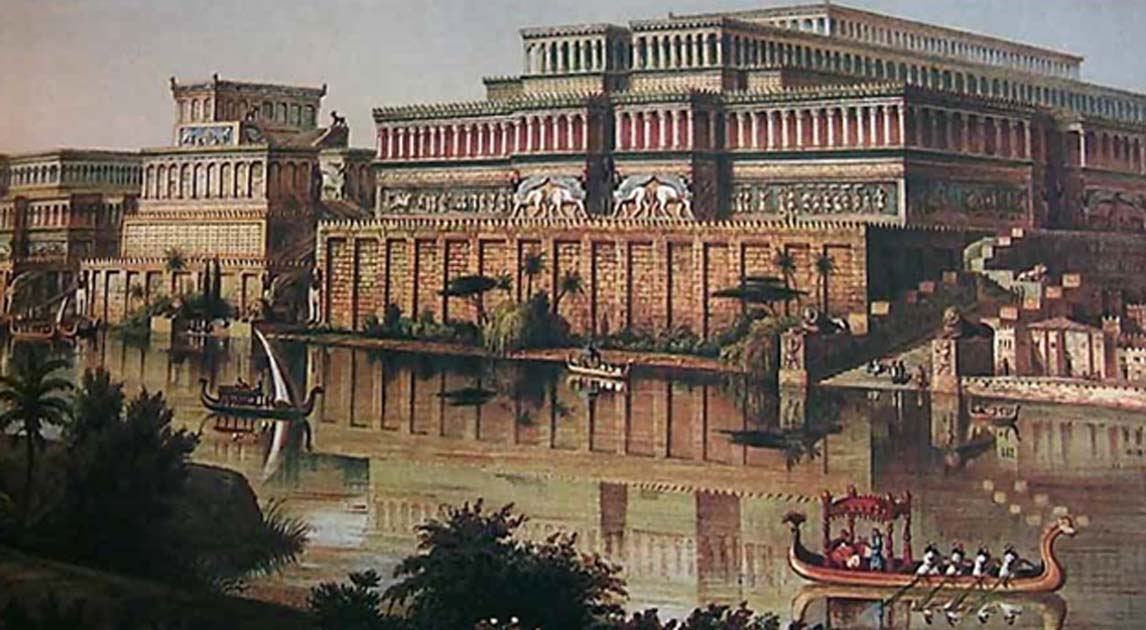
The Library of Ashurbanipal is one of the most important archaeological discoveries of the ancient world. Located in Nineveh, the capital of the Assyrian Empire (in what is now northern Iraq), this was the first systematically organized library in the ancient Middle East, created for the Assyrian king Ashurbanipal, who ruled from 669 to around 631 BCE.
The image above shows a grand, elevated library with wide stone steps, detailed Assyrian carvings, and a peaceful riverside location—highlighting its role as a proud center of learning, culture, and scholarship in ancient Nineveh.
Who was King Ashurbanipal?
Ashurbanipal ruled the Neo-Assyrian Empire from 668–627 BCE, a period when Assyria reached its greatest size and influence. He was unusual among ancient kings because he was literate and trained as a scribe, able to read and write Akkadian and Sumerian. This personal commitment to scholarship shaped his policies and inspired the creation of a royal library intended to preserve knowledge from earlier Mesopotamian civilizations.
Archaeologists later discovered over 30,000 tablets in the ruins of his palace. These discoveries included:
- Epics like “The Epic of Gilgamesh”
- Scientific and medical texts
- Omens, prayers, and incantations
- Dictionaries and bilingual lists
- Folk tales and myths
When Nineveh was destroyed by fire in 612 BCE, the clay tablets were accidentally preserved. The heat baked the clay, hardening them like pottery. This helped historians unlock thousands of years of Mesopotamian history, culture, and storytelling.
H.G. Wells described it as “the most precious source of historical material in the world.”
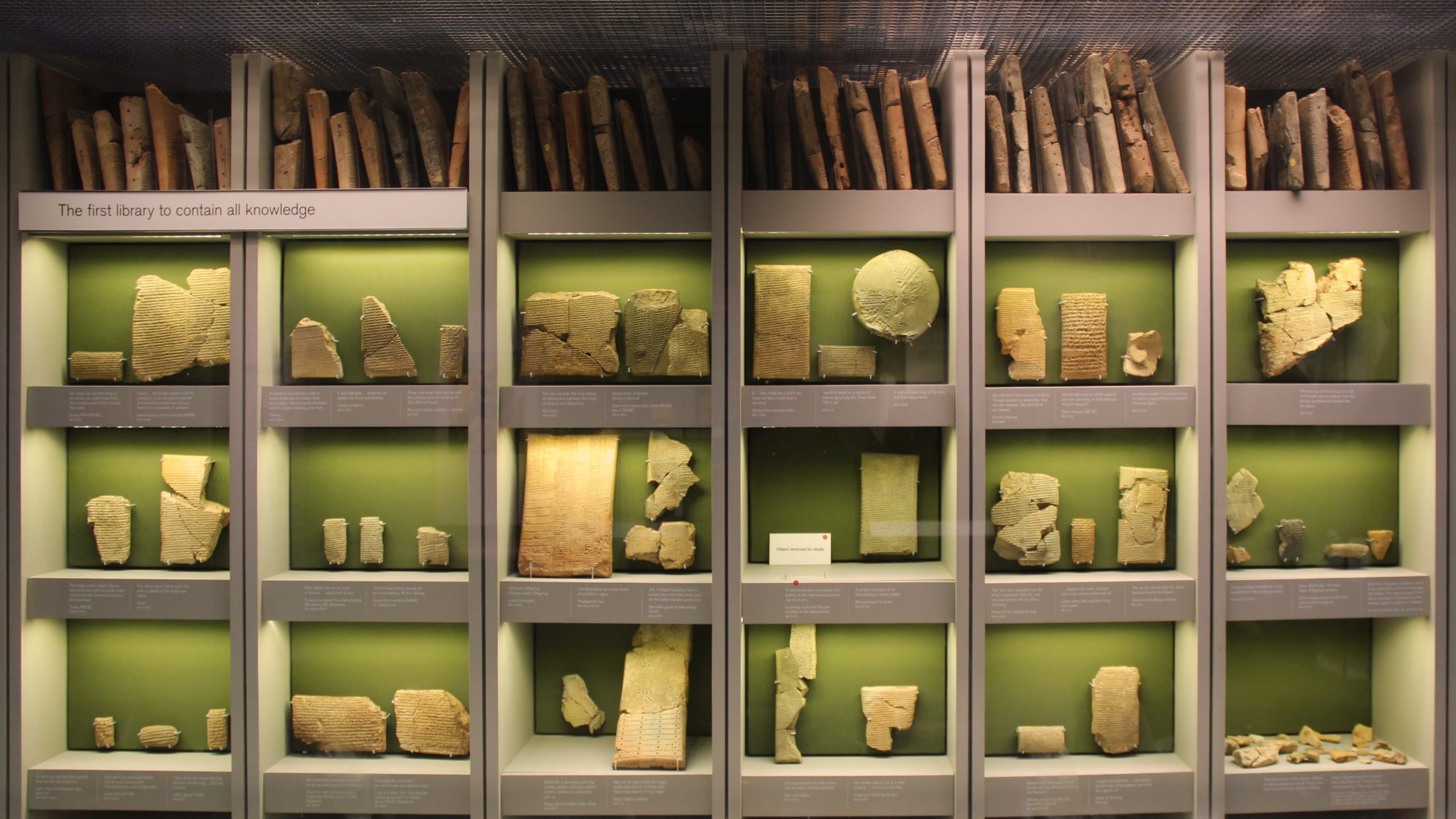
Where are the Tablets Today?
Many tablets from Ashurbanipal’s Library were unearthed in the mid-1800s by archaeologists such as Austen Henry Layard and Hormuzd Rassam. A large portion of the collection is now housed in the British Museum, where scholars continue to conserve, read, and translate them. Ongoing research still produces new insights into ancient science, literature, law, and daily life.
A library fit for a king – take a virtual tour of the British Museum using Google Street View. Click the button below to explore in 3D.
The Library of Alexandria, built several centuries after Ashurbanipal’s library in Egypt, was another early attempt to collect and preserve human knowledge. Unlike Ashurbanipal’s collection, which primarily focused on Mesopotamian writings, the Library of Alexandria aimed to gather scrolls from across the known world. While Ashurbanipal’s clay tablets were accidentally preserved in a fire, most of the scrolls in Alexandria were lost over time, highlighting the fragility of knowledge and the importance of preservation. Comparing the two libraries helps us understand how ancient civilizations valued information and the different ways they attempted to safeguard it for future generations.
What Was on the Tablets?
The clay tablets in Ashurbanipal’s library were more than just stories—they were the knowledge base of an entire civilization. Thanks to the accidental preservation of these tablets, we now have priceless information about how people lived, thought, healed, and believed in ancient Mesopotamia. All of this was written in cuneiform, the very first writing system in the world. It looks like a bunch of tiny wedge-shaped marks pressed into clay.
So how do we read these ancient tablets today? Meet Dr. Irving Finkel, a leading expert who has spent decades unlocking the language and knowledge preserved in cuneiform tablets
 Watch Dr. Finkel talk about the library and decoding cuneiform here: Watch here
As you learn about Cracking Ancient Codes and Cuneiform Writing with Dr. Irving Finkel, use the following questions to guide your research online or with your Parent/Teacher:
- What is cuneiform writing, and how was it made?
- Why is the Library of Ashurbanipal considered such a significant discovery?
- What was Ashurbanipal’s role in collecting these works?
- How does this library compare to the more famous Library of Alexandria, which was later destroyed?
- What can these texts tell us about life, science, religion, and storytelling in ancient Mesopotamia?
Vocabulary
- Cuneiform: The wedge-shaped writing system used in ancient Mesopotamia.
- Tablet: A flat piece of clay used as a writing surface in the ancient Near East.
- Scribe: A trained writer who recorded texts, laws, and accounts.
- Omen Texts: Writings that interpreted signs to predict the future.
- Catalogue/Colophon: Ancient labeling systems that identified a tablet’s series, owner, or shelf location.
Quick Timeline
- 668–627 BCE: Reign of Ashurbanipal in Nineveh.
- 612 BCE: Destruction of Nineveh; tablets are fired in the blaze and preserved.
- Mid-1800s: Major excavations; thousands of tablets recovered and brought to museums.
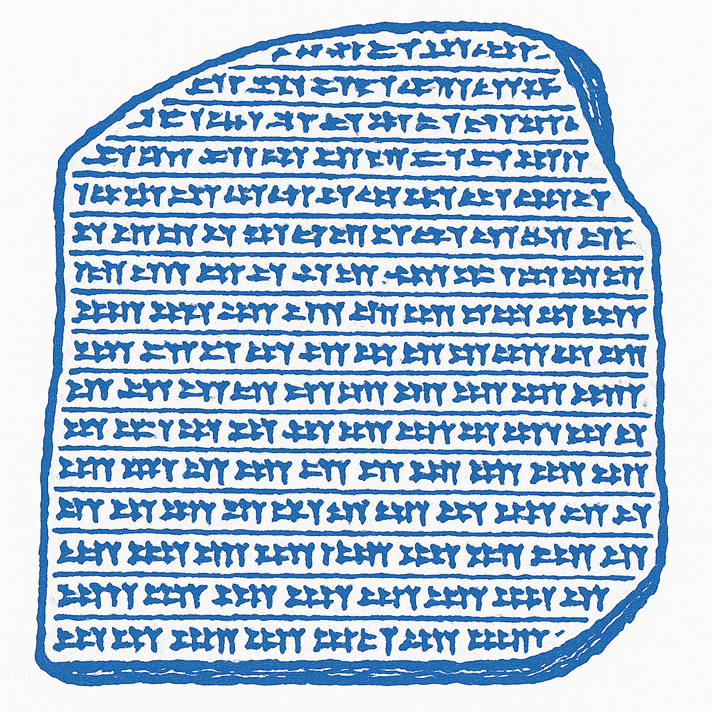
Cuneiform is the oldest form of writing in the world, used by the people of ancient Mesopotamia. It looks like rows of tiny wedge-shaped marks pressed into clay.
With Dr. Irving Finkel from the British Museum, you can learn how to write cuneiform yourself. Follow the tutorial below:
Create
Write a short summary (1–2 paragraphs) explaining:
- Who Ashurbanipal was
- Why his library is important
- What historians have learned from the tablets
You can also draw a simple diagram of what you think the library might have looked like, or illustrate a cuneiform tablet.
Research Poster: Secrets of Ashurbanipal’s Library
You will create a research poster to show what you’ve learned about the Library of Ashurbanipal and the ancient clay tablets. Your poster will include answers to these questions and colorful drawings or printed images to bring your work to life:
- What is cuneiform writing, and how did ancient scribes create it?
- Why do historians consider the Library of Ashurbanipal one of the most important discoveries in history?
- What was King Ashurbanipal’s role in gathering and preserving these works?
- How does this library compare to the famous Library of Alexandria, which was later destroyed?
- What do these ancient texts reveal about life, science, religion, and storytelling in Mesopotamia?
Materials You’ll Need
- Poster paper or a large sheet of paper
- Markers, crayons, or colored pencils
- Pencil for planning your sections
Optional: printed pictures from online (with help from a Parent or Teacher)
Below are resources for your Research Poster:
- A Library Fit For a King (British Museum)
- Library of Ashurbanipal (Wikipedia)
- Library of Ashurbanipal (World History)
Present Your Work: When you finish your poster, present it to your Parent or Teacher.
Conclusion
You’ve explored the Library of Ashurbanipal, learned about the first writing system in the world, and created a poster to share what you discovered. By presenting your work, you’ve become a historian—just like the experts who study these ancient tablets today.